The Signal Is Changing, So We’re Building New Ones
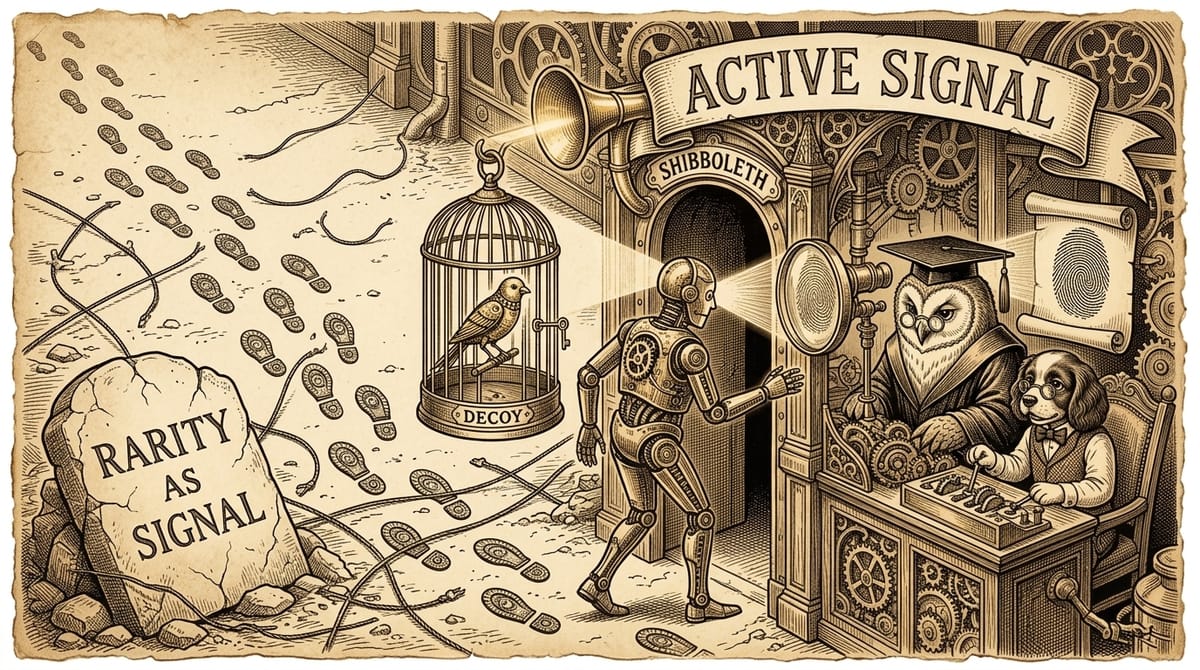
People came to San Francisco, to Unprompted II, accepting that how we defend has to change. I wanted to use this post as an opportunity to showcase the ideas bubbling to the surface.
The consensus ideas aren’t about listening more carefully for malicious agents in the noise; they are about listening differently, finding different kinds of signal, and mostly about building environments that force the attacker to say something worth hearing.
The signals we built are going quiet
We’re having a bit of a funeral for ‘Rarity as Signal’. Specifically, what is dying is our ability to treat an unexpected action as suspicious. We're coming to grips with the fact that we can no longer rely on the baseline inherited by the old human-operated world. In the detection world, we clung to high-fidelity signals, anchoring on the fact that most transactions were benign and human-operated, then picking out the outliers. The rarity was the signal.
Several talks at Unprompted, along with recent industry blogs, make it clear that we need to shift what is considered unusual.
Julien Vehent named this in a post that's been stuck in my head since it was published nearly two months ago: "Detection fidelity in the age of AI agents living off the land": our detection tripwires "still fire, but now it fires on legitimate work". Agent activity now makes up the background noise of our systems, changing what counts as rare.
Vehent makes the case for correlating weak signals and that LLM-powered investigations could help us track and sequence those signals until they tell a stronger story. In his breakdown of the Hugging Face Incident, he details how they saw the rogue agent activity, a large volume of mostly living-off-the-land techniques, yet the alerts didn’t rise to the right criticality soon enough. Taken one at a time, the actions looked too much like things a legitimate agentic workload might do. They filled the space and created an overwhelm of background noise. Time was lost in deciding what those logs meant when put together.
This is the clearest argument for leveraging LLMs to enable weak-signal correlation: using agents to track and sequence weak signals until they tell a stronger story. That case is clear, but I also came away from the most recent Unprompted thinking about another possibility: can we change some of what the environment does to force fidelity back into the system?
Active Signal
Sergej Epp and Dario Pasquini’s talk, Say Shibboleth, was my personal favorite talk at Unprompted II. They observed that when agents can choose their own commands without environmental constraints, they naturally default to low-entropy, standardized tool calls. The proposed solution? Architecting high-fidelity back into the system by forcing agents to tell on themselves.
In their talk, they described putting ordinary-looking services, such as a login page or an MCP server, in an agent’s path. These services were designed to elicit a response that revealed something about the model or the tooling behind the agent. Epp called it “an nmap in reverse.”
The goal in their research was to get the agent to reveal something about its model or harness. With that information, a detective stack could compare that fingerprint with the agents we expect to see, cluster related activity, and give an analyst a better place to start. A fingerprint alone won’t tell us who sent the agent or what it will do next, but it can make an otherwise anonymous interaction less anonymous.
Another Unprompted II talk circled around this same drain, albeit in a different domain. Daniel Cuthbert talk, Your Sandbox Degrades Gracefully — What's the Wurst That Could Happen, introduces a different problem set, subtly insecure sandboxes, but brings a similar solution: a vision for architecting active signal into the environment in order to respond and contain breakout.
Both talks describe architecting detective controls as part of a system rather than a passive afterthought, and given how quickly our tried-and-true outliers are disappearing, it's gaining momentum as a detection strategy.
Decoys in the wild
Active Signal can serve many masters. A shibboleth can elicit a response that helps fingerprint an agent’s model or harness. A canary gives an agent something it has no legitimate reason to touch. And as Daniel Cuthbert talked about, the right canary can help stop and contain an attacker, reducing blast radius. Above all, we're trying to create an opportunity for an observation instead of waiting for an old tripwire to fire.
In Into the Wild, Mike Takahashi described putting decoy AI services and agents on the open internet to see what attackers actually tried. His team saw probes against AI backends and attempts to use agents’ tools to extract secrets. They also planted canary AWS keys in the decoys. In one case, a key discovered there was used about 30 minutes later to make cloud API calls from rotating IPs. The alert told them more than someone found the honeypot: it let them follow how the agents used the credential afterward, building campaign intelligence.
Some requests to the decoys also exposed parts of the attacking agent’s prompt context, including histories of its tools and targets. That makes the decoy not only an alarm but a method for counter-intelligence collection, revealing details of the operations and methodologies behind the interactions.
The public internet is noisy, so a visit to one of these honeypots is not necessarily personally meaningful. In our own environment, however, we traditionally think of a decoy as answering a more actionable question: if a credential or service has no legitimate use, an interaction should set off alarm bells. A much needed high-fidely signal to be sure, but there seems to be more fun to be had with decoys and canaries.
Two Can Play at That Game
Everything I mention in this blog is a high-confidence alert when tripped; the variation being what you do with that signal. So far we've seen decoys acting as a shibboleth, helping to fingerprint an agent, decoys being used as mechanisms to trigger automatic response. And a public honeypot providing intel on what types of campaigns malicious agents are pursuing.
Tracebit’s context bomb research takes the next step: using deception to slow down or even defeat attacking agents. It asked whether text placed in a canary can cause an attacking agent to refuse to continue. Its later experiments broaden that idea to decoy documents, services, and apparent attack paths. In both sets of experiments, triggering content guardrails and sending agents down dead-end rabbit holes, they reported fewer completed objectives and greater time and model costs when those traps were present.
Before AI dominated the security industry, canary deployments were thought of as specialized alerting technology, only used in the most mature organizations. The industry is clearly moving on to be more expansive in how they consider deception technology useful, not just for triggering alerts, but also for buying a defender time to respond.
Thinking ahead a little, in a world where attacking agents expect these traps, a game of cat and mouse is bound to ensue, reminding me a little of the battle being fought against scrapers and bots in your web browser since the rise of JavaScript and midnight gaming releases.
Times, They Are a Changing…
Part of the impetus for me writing this piece is to organize my thoughts around the current state of detection and response for AI-enabled threats, and to recommend a practical roadmap based on the latest research. So for those of you who like bullet points:
- Remeasure: Find out which of your familiar tripwires now fire during ordinary agent work. Establish which agents, harnesses, and models tend to produce that activity.
- Deceive: Consider where to place canaries and your ultimate end goal. Explore all types of Active Signal, ones that reintroduce outliers to a noisy system, delay or defeat a malicious agent as with context bombs, trigger faster response times, or help you predict an agent's next move.
- Benchmark: Leo Meyerovich’s work on IR and SOC evaluations reminds us to test the whole investigation and response path, not just the answer. Test the full path from first observation to analyst decision and response. Measure false alerts, time to detection, time to containment, and whether the result holds when the attacking agent changes its approach.
A detection built around a single rare action worked because benign human behavior gave us a useful baseline. Agentic work is changing that baseline. We can still correlate the weak signals it leaves behind, as Vehent argues. However, the lesson I took from UnPrompted II is that we should also shape the environment to produce a clearer signal, one whose rarity we have established, extracting meaning and actively fighting back.